
 Macao, Macau
Macau
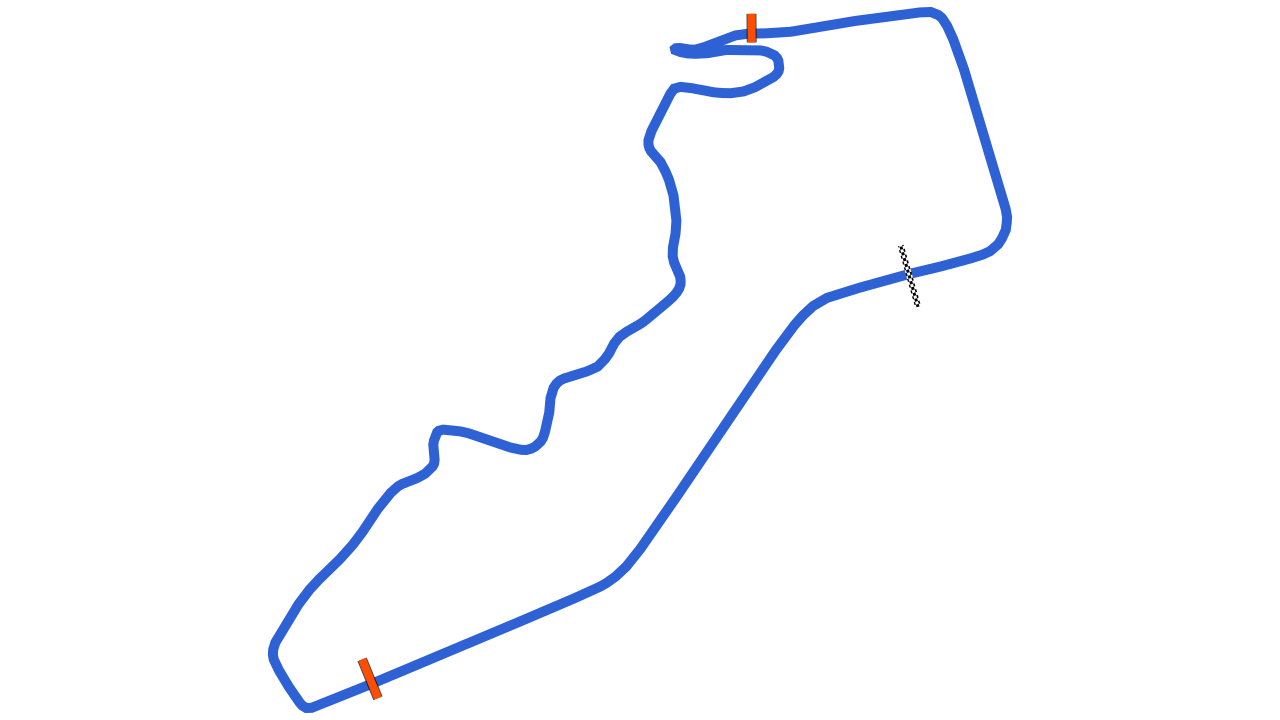
A 6.117 km circuit in Macau. Timed layouts, lap times and what you need to know before a track day here.
Going to Macau?
See which corner costs you the most time.
Record the session on your phone. Vetkuro splits the laps, times every sector and shows where the gap to your best lap opens.
Filming your laps?
Put speed, delta and lap time on your onboard video.
Overlay the data from the same session on the footage, synced automatically. One file to watch back, or to share.
Driving with friends?
Find out who is faster, and in which corner.
Overlay two laps from the same day and see exactly where the gap opens, not only the final number.
Recorded on Vetkuro · No sessions yet
Macau lap times
Timed from GPS on real track days, not typed in. Compare within one layout and one vehicle class, because a motorcycle lap and a car lap are not the same thing.
No recorded laps on Guia Circuit (Macau Grand Prix) yet.
Record a session on this layout and your lap becomes the time other drivers in your class compare against.
Track day guide
Track day at Macau
Weather by month, who runs the days and what to put in the car. Written for a first visit.
Who runs track days here
What to bring
- Helmet that meets the organiser's standard
- Long sleeves, long trousers, closed shoes
- Tyre pressure gauge, since pressures rise fast on track
- Removable towing eye fitted or in the car
- An empty boot: loose items out before the first session
- Your phone in a rigid mount, recording with Vetkuro
Weather by month
Now, in November: 24°C by day, 22°C at night, rain on 7 days. Warmest in July, 30°C by day on average. Coldest in January, 17°C at night. Fewest days with rain: December.
Rain: days with rain per month. Climate: NASA POWER, daily data 2016–2025. Monthly averages, not a forecast. Check the organiser's calendar for open dates. The data was obtained from the National Aeronautics and Space Administration (NASA) Langley Research Center's Prediction Of Worldwide Energy Resources (POWER) project funded through the NASA Earth Science Division.
Elevation profile
Macau elevation
Elevation change 40 m, steepest gradient 15.6%. The highest point, about 43 m above sea level, is 2.59 km from the start line; the lowest, about 3 m, 5.64 km.
Height above sea level, approximate. HoverTouch the profile for any point.
From a terrain model, sampled every 10 m along the track line and smoothed over 100 m. Heights above sea level are approximate: trees and buildings along the line read up to about 15 m high. Produced using Copernicus WorldDEM-30 © DLR e.V. 2010-2014 and © Airbus Defence and Space GmbH 2014-2018 provided under COPERNICUS by the European Union and ESA; all rights reserved. The organisations in charge of the Copernicus programme by law or by delegation do not incur any liability for any use of the Copernicus WorldDEM-30.
Going to Macau?
More to do with the session than the lap time
About Macau
Overview
The Guia Circuit is a street circuit in the south-east of the Macau Peninsula whose public roads are closed to traffic for the Macau Grand Prix. The event is organised by the Macau Grand Prix Organizing Committee and combines several races on one weekend: the single-seater race that carries the Grand Prix title, the Macau Motorcycle Grand Prix, the Guia Race for touring cars and the GT Cup, which the FIA recognised as the FIA GT World Cup in 2015. Its mix of fast straights and tight corners between walls has earned it a reputation as one of the hardest street tracks in the world.
Technical Specifications and Track Features
The lap of 6,120 m falls into two very different halves. Along the waterfront a series of straights, broken by the R bend and the corner by the Mandarin Oriental hotel, lets Formula 3 cars pass 260 km/h before braking for Lisboa, a 90-degree bend where accidents are common, especially on the opening lap. The second straight is the widest part of the track, at about 14 m. From Lisboa the road climbs San Francisco Hill and enters the hill section, a narrow sequence of bends that includes Maternidade, Solitude and Dona Maria before the Melco hairpin. At about 7 m, Melco is the narrowest point of the circuit and is taken in first gear, with contact against the guard rail hard to avoid. The Fisherman's straight then runs back to the R bend. The height of the lap varies by more than 30 m, and barriers painted in black and yellow stripes line the whole circuit.
Facilities and Specialized Areas
The pit and paddock complex was moved to a new site in 1993, the only significant change to the course since 1957, and the same work removed a gravel trap at the Reservoir bend. Spectators watch from two main grandstands, one along the pit straight and one at Lisboa. The Grand Prix Museum, opened during the 40th Macau Grand Prix in 1993, presents the history of the event and displays an architectural model of the circuit.
History
The route was first laid out in 1954 for a treasure hunt through the streets, and soon afterwards local enthusiasts proposed using it for a race. Fernando Macedo Pinto is named among the founders of the Grand Prix, and the circuit opened on 31 October 1954 with a race for sports cars. The original course was slightly longer and was given its lasting shape in 1957. The main race became a Formula Libre event in 1961 and remained amateur until 1966, when Mauro Bianchi's Alpine drew professional teams to Macau. The Motorcycle Grand Prix was added in 1967, the year in which Dodjie Laurel was killed at the Mandarin bend, and safety was improved afterwards. In 1983 the Grand Prix switched to Formula 3, and Ayrton Senna won the first race under the new rules. Michael Schumacher won in 1990 on aggregate time after a collision with Mika Häkkinen, and David Coulthard, Ralf Schumacher and Takuma Sato are among later winners. The World Touring Car Championship visited from 2005 to 2014, and the FIA F3 World Cup was held at the meeting between 2016 and 2019 and again in 2023.
