Germany, Papenburg
Papenburg
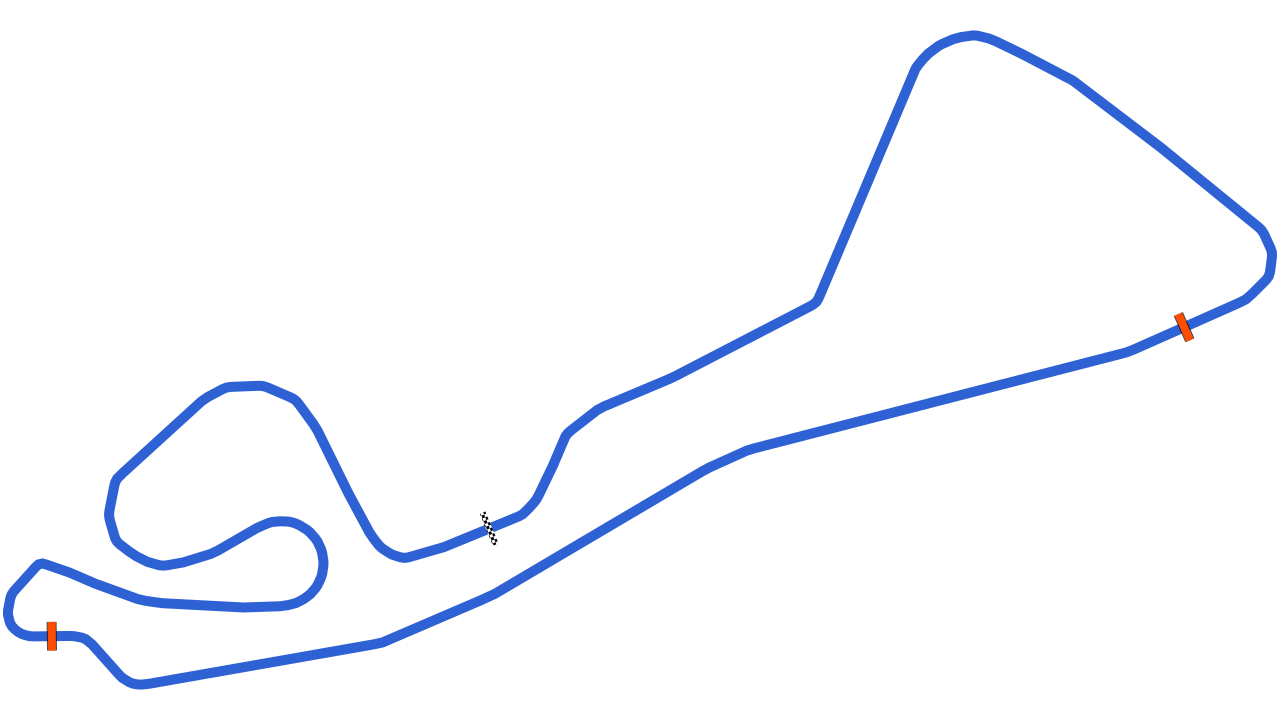
A 2.606 km circuit in Papenburg. Timed layouts, lap times and what you need to know before a track day here.

Going to Papenburg?
See which corner costs you the most time.
Record the session on your phone. Vetkuro splits the laps, times every sector and shows where the gap to your best lap opens.
Filming your laps?
Put speed, delta and lap time on your onboard video.
Overlay the data from the same session on the footage, synced automatically. One file to watch back, or to share.
Driving with friends?
Find out who is faster, and in which corner.
Overlay two laps from the same day and see exactly where the gap opens, not only the final number.
Recorded on Vetkuro · No sessions yet
Papenburg lap times
Timed from GPS on real track days, not typed in. Compare within one layout and one vehicle class, because a motorcycle lap and a car lap are not the same thing.
No recorded laps on Papenburg Handlingkurs yet.
Record a session on this layout and your lap becomes the time other drivers in your class compare against.
Track day guide
Track day at Papenburg
Weather by month, who runs the days and what to put in the car. Written for a first visit.
Who runs track days here
What to bring
- Helmet that meets the organiser's standard
- Long sleeves, long trousers, closed shoes
- Tyre pressure gauge, since pressures rise fast on track
- Removable towing eye fitted or in the car
- An empty boot: loose items out before the first session
- Your phone in a rigid mount, recording with Vetkuro
Weather by month
Now, in November: 9°C by day, 4°C at night, rain on 15 days. Warmest in August, 23°C by day on average. Coldest in January, 0°C at night. Fewest days with rain: March to May.
Rain: days with rain per month. Climate: NASA POWER, daily data 2016–2025. Monthly averages, not a forecast. Check the organiser's calendar for open dates. The data was obtained from the National Aeronautics and Space Administration (NASA) Langley Research Center's Prediction Of Worldwide Energy Resources (POWER) project funded through the NASA Earth Science Division.
Elevation profile
Papenburg elevation
Elevation change 2 m. That is within the margin of the terrain model, so Papenburg counts as flat and there is no profile to draw.
From a terrain model, sampled every 10 m along the track line and smoothed over 100 m. Produced using Copernicus WorldDEM-30 © DLR e.V. 2010-2014 and © Airbus Defence and Space GmbH 2014-2018 provided under COPERNICUS by the European Union and ESA; all rights reserved. The organisations in charge of the Copernicus programme by law or by delegation do not incur any liability for any use of the Copernicus WorldDEM-30.
Going to Papenburg?
More to do with the session than the lap time
About Papenburg
Overview
The Papenburg proving ground is run by ATP Automotive Testing Papenburg GmbH on the edge of Papenburg, a town on the river Ems in north-west Germany. The operator calls it one of the largest manufacturer-independent automotive test grounds in the world. The site covers 780 hectares inside its fence and is used by car and truck makers, suppliers and developers of passenger and commercial vehicles for testing and engineering work. It is not a public race circuit, but partner companies run track days on the site, and the operator offers driver training. The nearest railway stations are Papenburg (Ems) and Leer, and the nearest airports Bremen and Münster/Osnabrück.
Technical Specifications and Track Features
The handling course is 2.6 km long and 10 metres wide. It was laid out as a copy of the short circuit at Hockenheim and can be split into two independent courses. The site's largest track is a high-speed oval with banked curves of up to 49.7 degrees, built for cornering without lateral force at up to 250 km/h. Each of its two straights is four kilometres long with five lanes, and the curves have six lanes. Other test tracks include an acoustic track, braking test sections, endurance courses, a city endurance route, a rough-road track, a twist road, banked lanes and climbing ramps with gradients of up to 18 percent.
Facilities and Specialized Areas
The vehicle dynamics area combines a circle 300 metres across with a trapezoid-shaped surface up to 100 metres wide, fed by several access roads. A separate wet handling course is 5 metres wide and has several watering modules, a section for lateral aquaplaning and an integrated skid pad, with rings of asphalt and blue basalt, next to a small workshop. The operator also rents out workshops and carries out engineering work on vehicle dynamics, brakes, endurance and load data. The operator runs safety training for cars, motorcycles, vans, trucks, tankers, buses and chauffeurs, as well as graded test track licence courses at three levels, which are open only to industrial customers.
History
Building the proving ground meant moving 3.5 million cubic metres of peat and dredging 4.5 million cubic metres of sand, and about 900,000 tonnes of asphalt went into roughly 75 kilometres of roads. The project cost about 150 million euros, and the site opened in autumn 1998. Its quality management has been certified since 2000. Several new workshop buildings and a test stand building were added after the opening. The Osnabrück coachbuilder Karmann once held 60 percent of ATP, and after Karmann's insolvency the engineering firm MBtech raised its stake to 100 percent in August 2011.